

Vision Zero Street Labs are a great way to work with the City to bring traffic safety improvements to your neighbourhood using traffic-calming measures.
Each Street Lab project is tailored to the unique needs of the community to creatively address neighbourhood traffic safety concerns such as speeding, short-cutting and other unsafe driving behaviours.
Upcoming Street Labs Engagements
May 27-June 17, 2026 in: Brintnell, Crystallina Nera West, Ogilvie Ridge and Hodgson, Sakaw and York.
Street Lab Neighbourhoods
Please note: Street Labs before 2023 were primarily community-led with the process varying across neighbourhoods. As a result, the life cycles of these Street Labs did not follow the current steps or the documentation available to the public.
| Neighbourhood | Step | Documents | Lifecycle | ||
|---|---|---|---|---|---|
| Abbottsfield and Rundle Heights | Engagement | Abbottsfield and Rundle Heights Engagement Public Notice |
| ||
| Argyll | Engagement | Argyll Engagement Public Notice |
| ||
| Allard | Street Lab in Place |
| |||
| Ambleside | Street Lab in Place | Ambleside Street Lab Plan: Phases One and Two |
| ||
| Avonmore | Street Lab in Place | Avonmore Street Lab Plan |
| ||
| Avonmore (Community Led) | Street Lab in Place |
| |||
| Balwin (Community Led) | Street Lab in Place |
| |||
| Blackmud Creek | Engagement | Blackmud Creek Engagement Public Notice |
| ||
| Beverly Heights | Install |
| |||
| Beverly Heights (Community Led) | Street Lab in Place |
| |||
| Blue Quill/Sweet Grass (Community Led) | Street Lab in Place |
| |||
| Bonnie Doon | Street Lab in Place |
| |||
| Brander Gardens (Community Led) | Street Lab in Place |
| |||
| Britannia Youngstown | Install |
| |||
| Brintnell | Engagement | Brintnell Engagement Public Notice |
| ||
| Callingwood North | Install | Callingwood North Engagement Public Notice |
| ||
| Callingwood South | Create Plan |
| |||
| Carlton | Street Lab in Place |
| |||
| Carter Crest (Community Led) | Street Lab in Place |
| |||
| Casselman and McLeod | Engagement | Casselman and McLeod Engagement Public Notice |
| ||
| Crystallina Nera West | Engagement | Crystallina Nera West Public Engagement Notice |
| ||
| Davies Industrial West/Wagner Road (Community Led) | Street Lab in Place |
| |||
| Delton | Install |
| |||
| Dovercourt (Community Led) | Street Lab in Place |
| |||
| Eaux Claires/Belle Rive | Create Plan |
| |||
| Evansdale | Install |
| |||
| Falconer Heights | Create Plan |
| |||
| Fulton Place | Create Plan |
| |||
| Glengarry | Install |
| |||
| Greenfield | Create Plan |
| |||
| Greenview | Engagement | Greenview Engagement Public Notice |
| ||
| Grovenor (Community Led) | Street Lab in Place |
| |||
| Grovenor | Engagement | Grovenor What We Heard |
| ||
| High Park | Street Lab in Place |
| |||
| Idylwylde | Street Lab in Place |
| |||
| Jackson Heights | Create Plan |
| |||
| Kenilworth | Create Plan |
| |||
| Kiniski Gardens | Engagement | Kiniski Gardens Engagement Public Notice |
| ||
| Laurel | Street Lab in Place |
| |||
| Lendrum Place | Engagement | Lendrum Place Engagement Public Notice |
| ||
| Lymburn | Create Plan |
| |||
| Magrath Heights (Community Led) | Street Lab in Place |
| |||
| Matt Berry | Engagement |
| |||
| Mayfield | Street Lab in Place |
| |||
| McConachie (Community Led) | Street Lab in Place |
| |||
| McKernan | Street Lab in Place | McKernan Installation Public Notice McKernan Street Lab Evaluation Summary |
| ||
| McQueen | Create Plan |
| |||
| Miller | Create Plan |
| |||
| Newton | Street Lab in Place |
| |||
| Northmount | Street Lab in Place |
| |||
| Ogilvie Ridge and Hodgson | Engagement | Ogilvie Ridge/Hodgson Public Engagement Notice |
| ||
| Oliver (Community Led) | Street Lab in Place |
| |||
| Parkallen | Street Lab in Place |
| |||
| Parkdale | Street Lab in Place |
| |||
| Parkview | Street Lab in Place |
| |||
| Queen Alexandra (Community Led) | Street Lab in Place |
| |||
| Rapperswill | Engagement | Rapperswill Engagement Public Notice |
| ||
| Ritchie | Street Lab in Place |
| |||
| Rosenthal (Community Led) | Street Lab in Place |
| |||
| Sakaw | Engagement | Sakaw Public Engagement Notice |
| ||
| Silver Berry | Street Lab in Place |
| |||
| Spruce Avenue | Create Plan |
| |||
| Summerside | Street Lab in Place | Summerside Street Lab Plan |
| ||
| Terrace Heights | Engagement | Terrace Heights Engagement Public Notice |
| ||
| The Hamptons (Community Led) | Street Lab in Place |
| |||
| The Orchards at Ellerslie | Street Lab in Place |
The Orchards at Ellerslie What We Heard |
| ||
| Webber Greens | Street Lab in Place | Webber Greens Phase 1 Public Notice Webber Greens Phase 2 Public Notice |
| ||
| Weinlos | Create Plan |
| |||
| Wellington | Street Lab in Place |
| |||
| Westmount (Community Led) | Street Lab in Place |
| |||
| Westwood (Community Led) | Street Lab in Place | Westwood Street Lab Installation Public Notice |
| ||
| Wild Rose | Install | Wild Rose What We Heard Wild Rose Installation Public Notice |
| ||
| Woodcroft | Install |
| |||
| York | Engagement | York Public Engagement Notice |
|
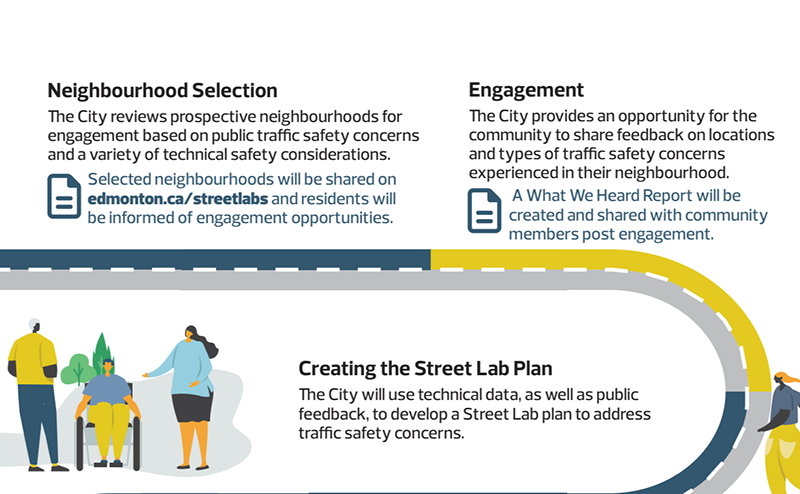
Vision Zero Street Labs follow a 5-step process.
The City reviews prospective neighbourhoods for Vision Zero Street Labs engagement based on public traffic safety concerns, collision data, existing safety improvements and other technical considerations.
If your neighbourhood is selected for Street Lab engagement, the City will explore residents’ perspectives and gain insights into their lived experiences and traffic safety concerns.
Community members in the neighbourhoods selected for engagement have the opportunity to identify locations of traffic safety concerns in their neighbourhood on an interactive online map as a part of public engagement.
A What We Heard Report will be published with the findings and the results of the public engagement will be used in combination with technical data to determine the next steps.
The City staff will use engagement results and collected traffic data along with City design and construction standards, federal and provincial transportation infrastructure legislation and engineering technical expertise to develop a Street Lab plan that effectively addresses the identified traffic safety concerns. This plan will be shared with residents. See examples of traffic-calming measures below that may be included in the Street Lab plan.
City staff will bring the Street Lab to life by installing traffic-calming measures to address traffic safety concerns.
Traffic-calming measures may include:
- Curb extensions
- Two-stage crossings
- Centre medians
- Speed humps or speed tables
- Pavement markings and reflective posts
The City will review traffic data and community feedback received through 311 to assess if any adjustments are needed over a 6-9 month period following the completion of the Street Lab installation.
An Assessment Summary will be published when available. It will include whether any adjustments are needed.
The Street Lab has been installed, assessed and is currently active in the neighbourhood. Community members can continue to share any concerns or maintenance requirements through 311.
Examples of Street Lab Installations
Street Labs use traffic calming measures to address specific traffic safety concerns. Some of these measures may be installed in your neighbourhood.
Speed Humps and Speed Tables
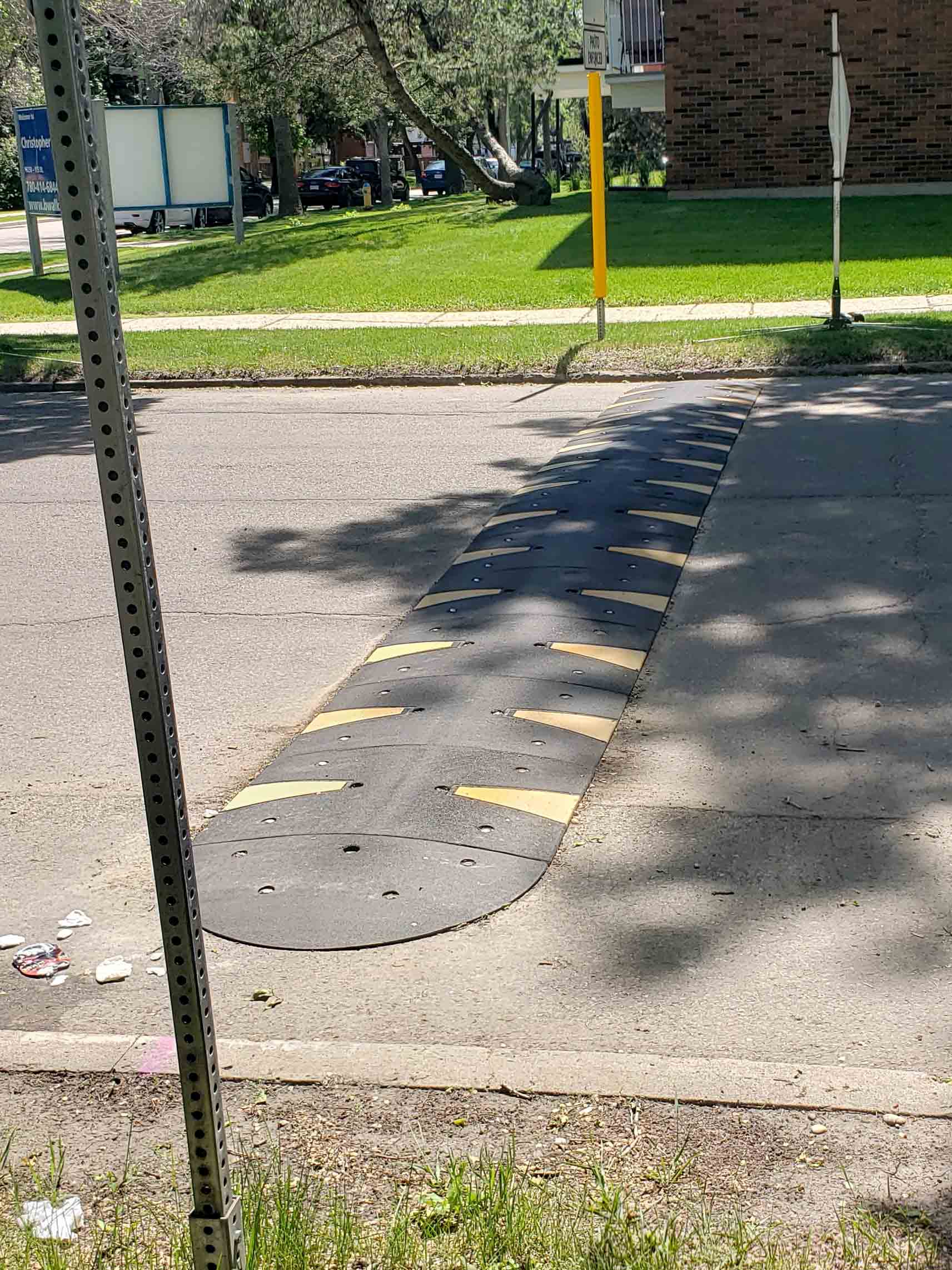
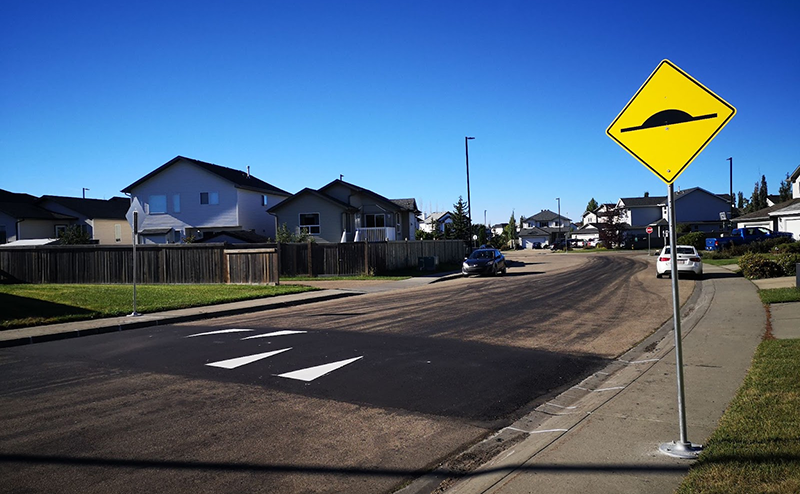
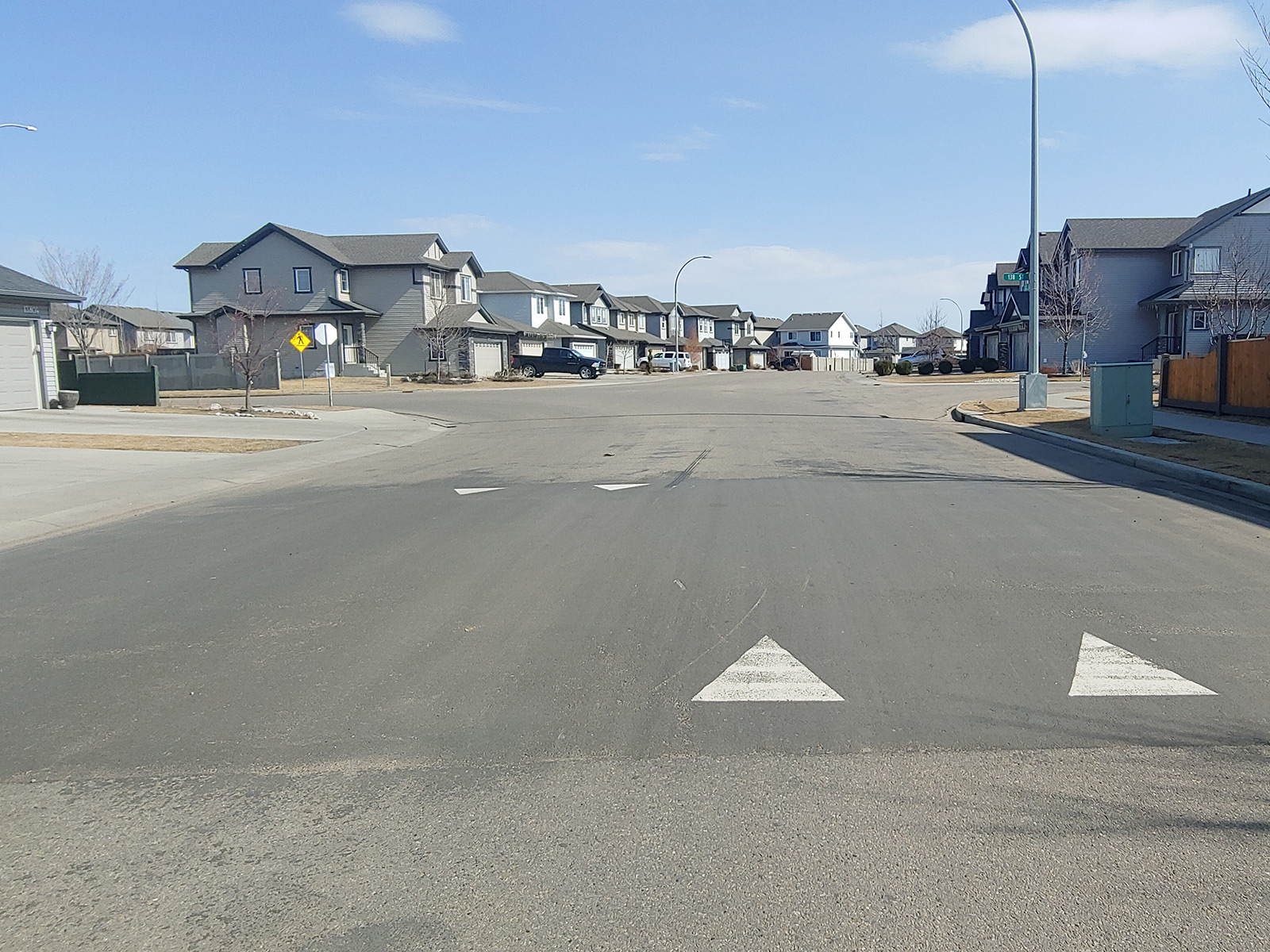
Benefits include:
- Encourages safer speeds
- Discourages shortcutting
- Increases safety for people walking, biking, rolling and driving
When you see one:
- Slow down and be aware of others
- A typical speed to comfortably drive over speed humps and speed tables would be 20 km/h
Two Stage Crossings
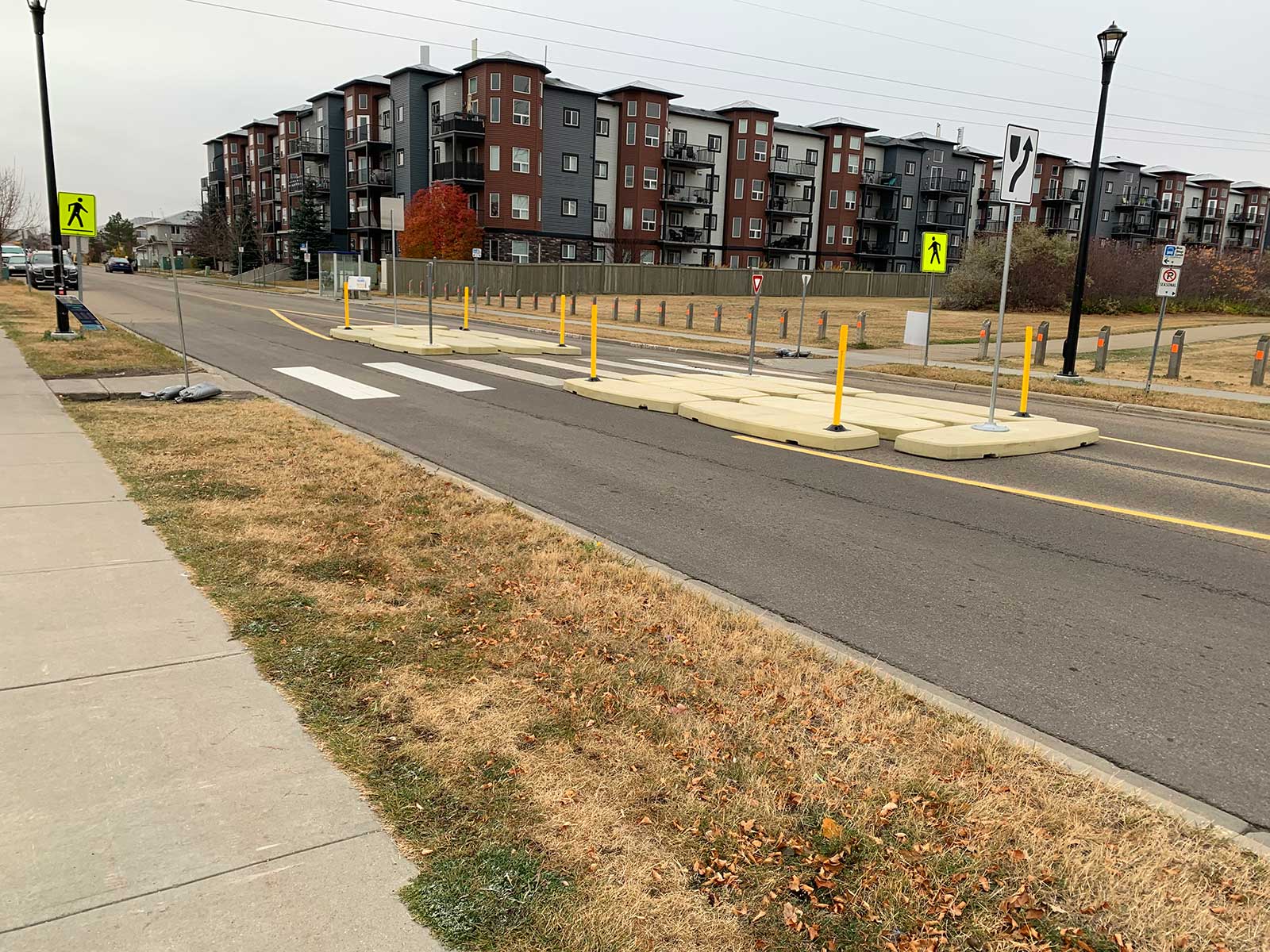
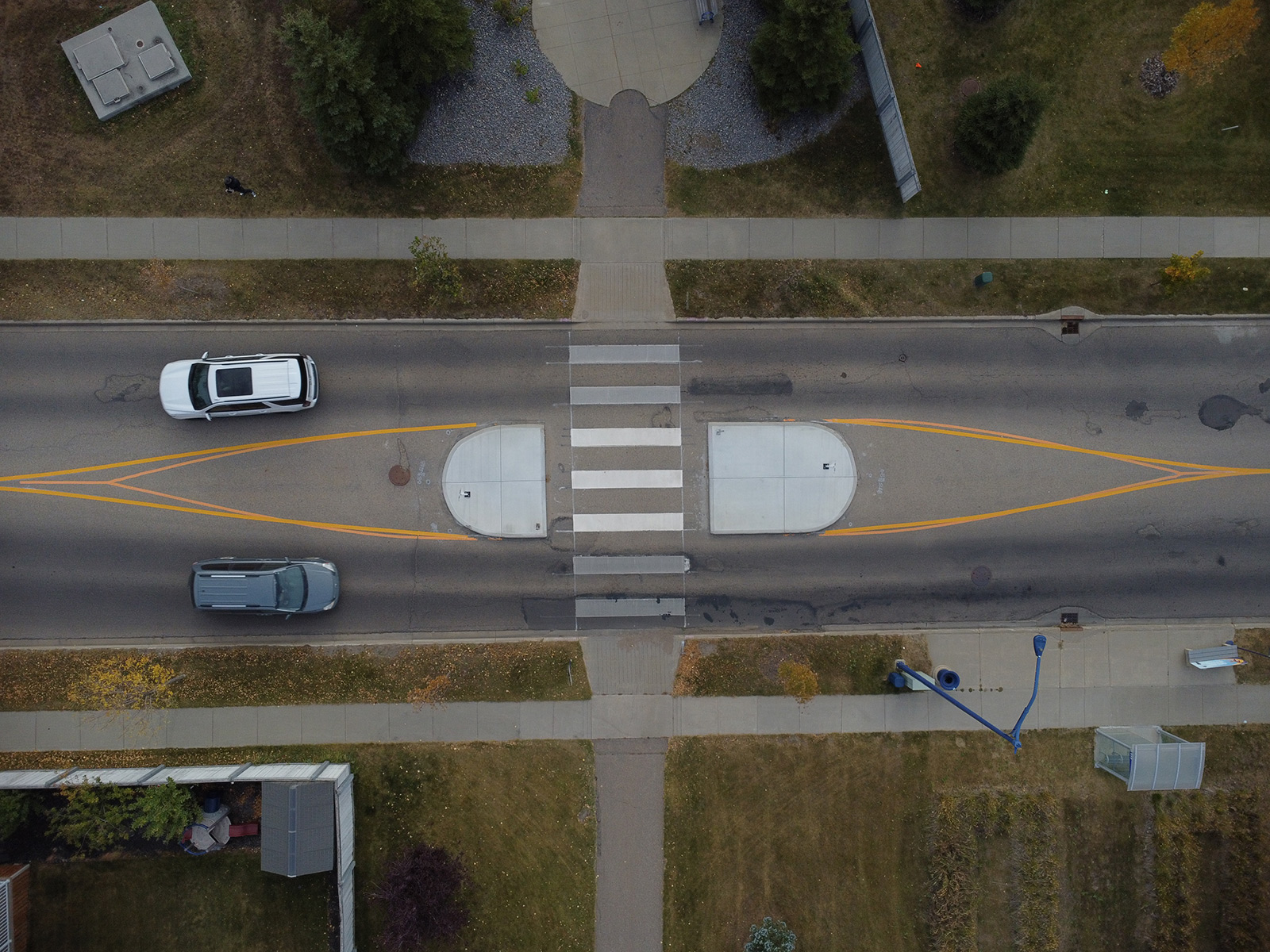
Benefits include:
- Encourages safer speeds
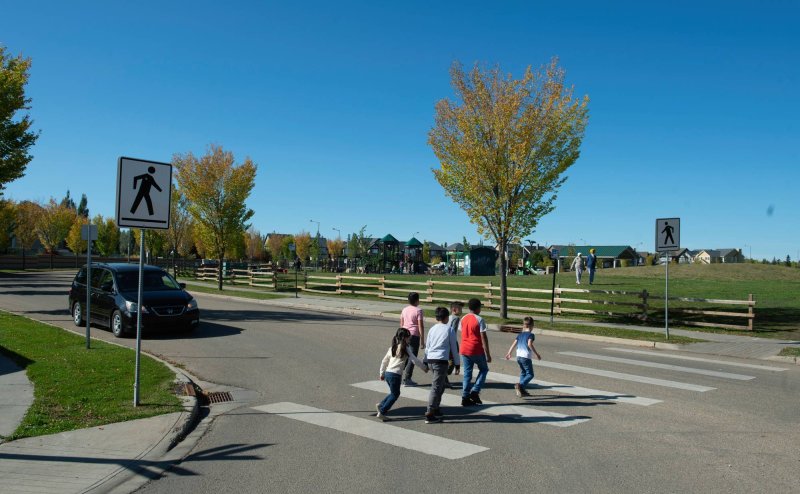
- Increases pedestrian visibility
- Allows people who walk or bike to cross one direction of traffic at a time
When you see one:
- Slow down and be aware of others while driving
- People walking have right-of-way when crossing
- People biking or using a shared e-scooter must yield to vehicles and pedestrians before crossing one lane at a time
Curb Extensions
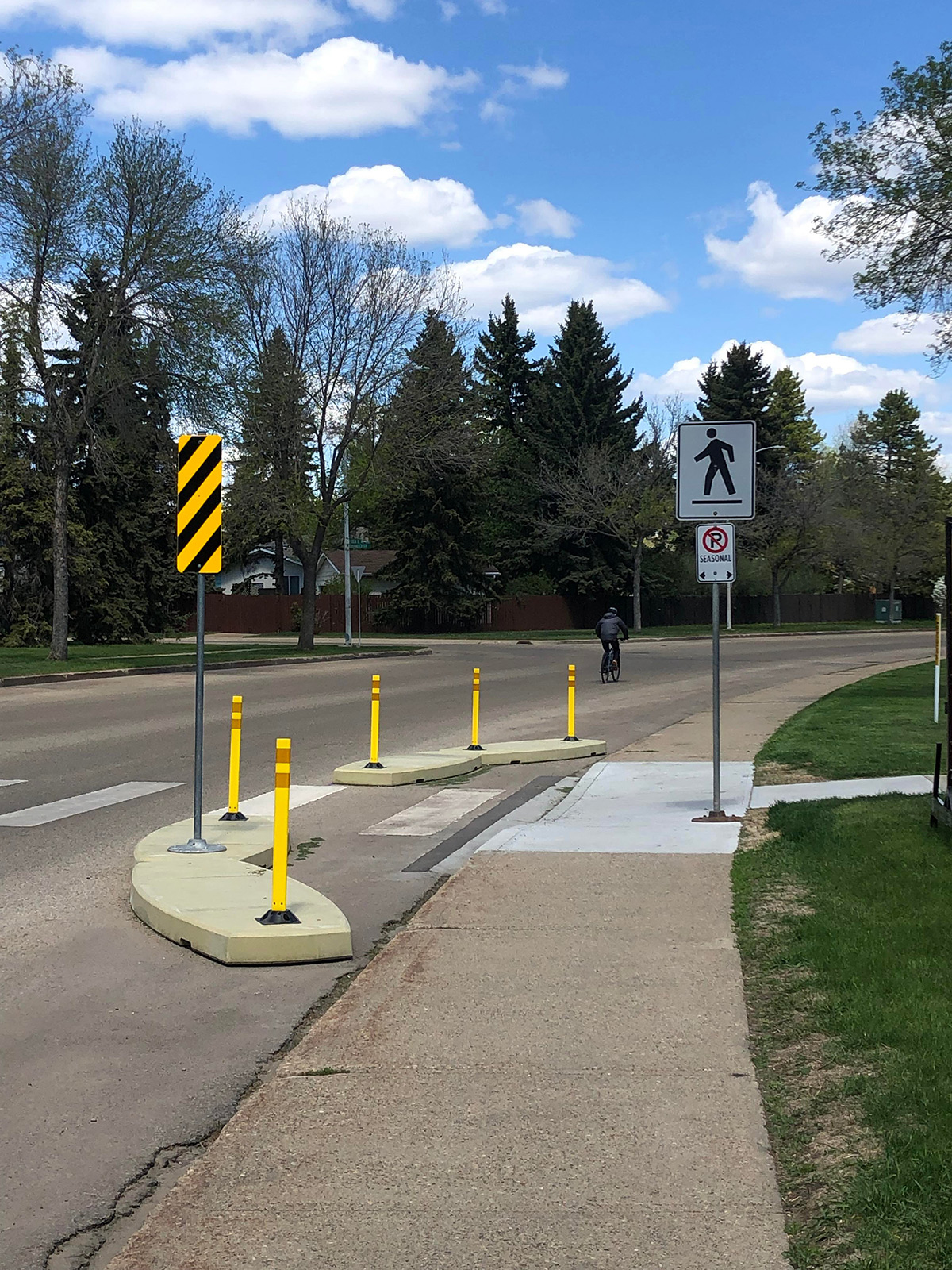
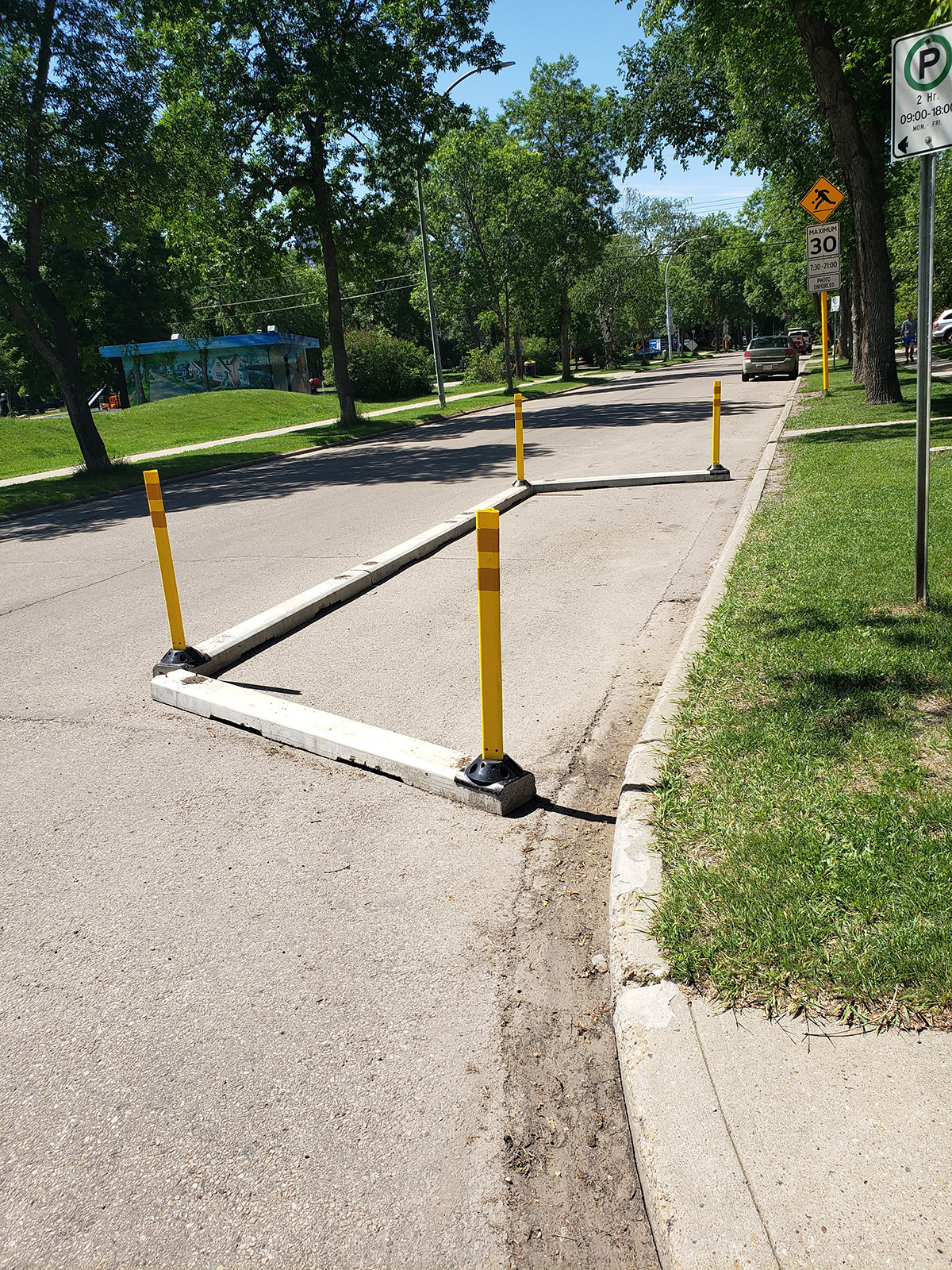
Benefits include:
- Shortens crossing distances
- Encourages safer speeds
- Increases pedestrian visibility by eliminating parking too close to the crosswalk, creating clearer sightlines for all road users
When you see one:
- Slow down and be aware of others
- Pedestrians have the right-of-way when crossing
Centre Medians
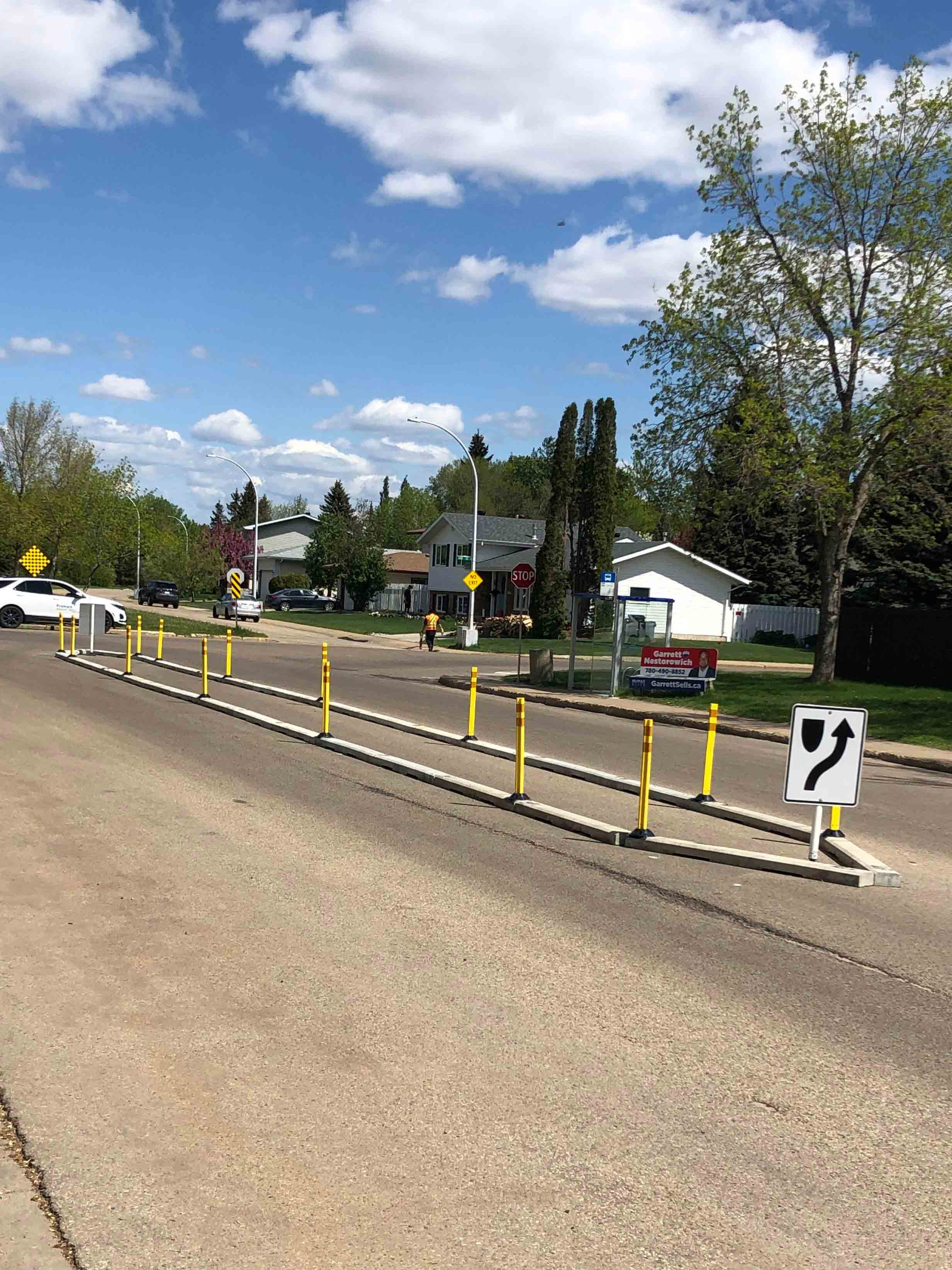
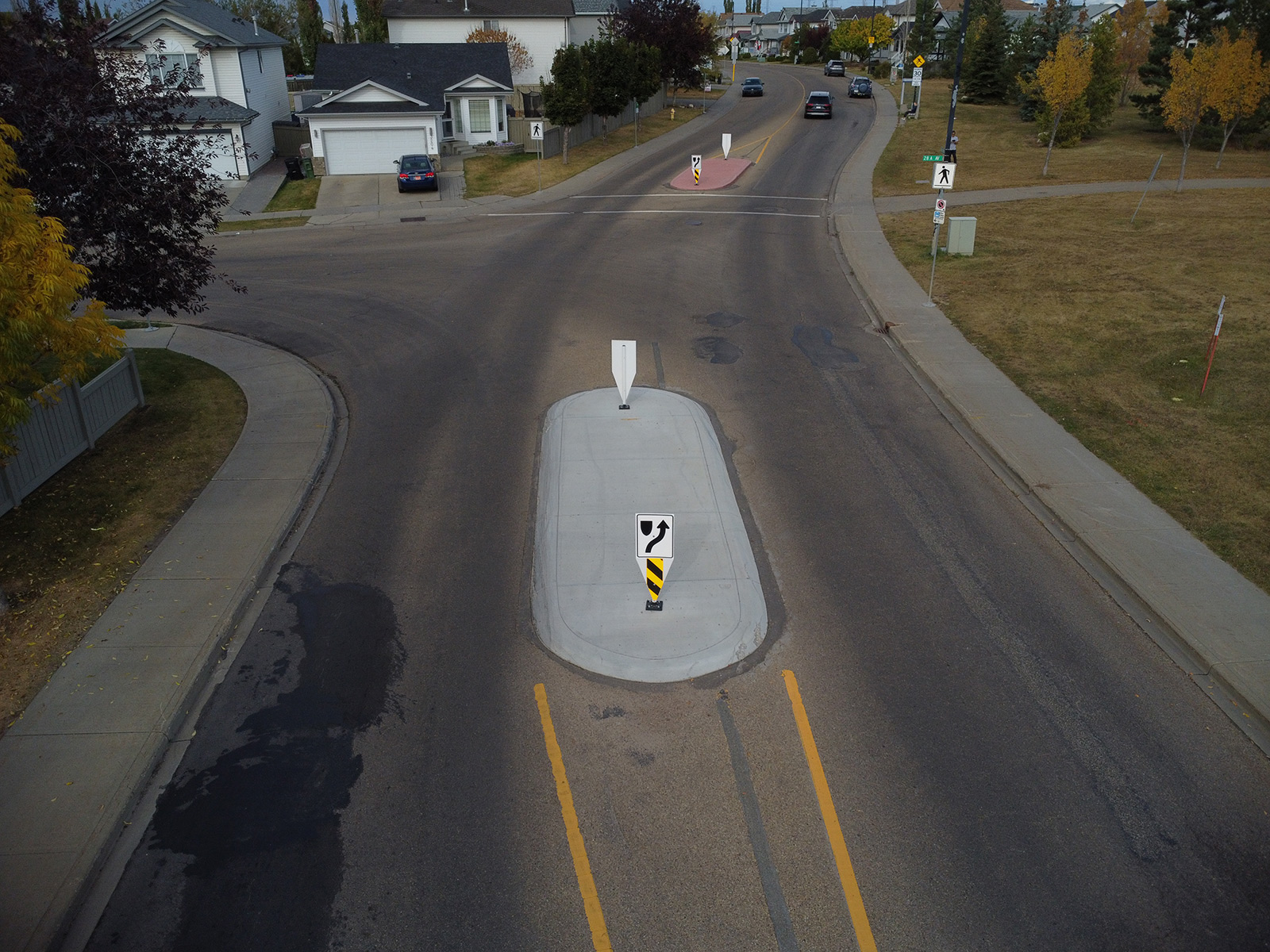
Benefits include:
- Encourages safer speeds
- Keeps drivers in the proper lane
- Improves pedestrian visibility
When you see one:
- Slow down and be aware of others
- Pedestrians have the right-of-way when crossing at intersections and marked mid-block crossings
Pavement Markings and Reflective Posts
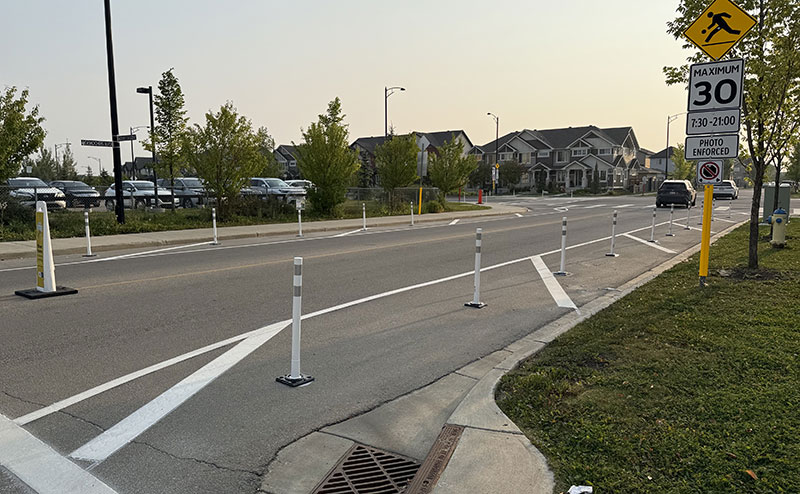
Benefits:
- Prevent parking within no stopping and no parking zones
- Keep drivers in the driving lane
- Improve pedestrian visibility
When you see one:
- Slow down and be aware of others
Frequently Asked Questions
Vision Zero Street Labs are a data-driven solution to improving traffic safety in a neighbourhood in a quick and cost-effective manner. It provides the neighbourhood and its residents with:
- A forum to share their experiences on their neighbourhood streets
- An opportunity to implement traffic safety solutions using a variety of traffic-calming measures
- Meaningful options to improve traffic safety
While Street Labs focuses on addressing traffic safety concerns in residential neighbourhoods, certain road types are out of scope:
- Arterial roads (60 km/h)
- Alleyways
- Private property (example: schools, businesses)
The following traffic safety policies and projects that are covered by other City of Edmonton programs are not included in Street Labs:
- Additional traffic enforcement from Edmonton Police Service
- Speed limit changes
- Snow and Ice policy (such as frequency of snow clearing, windrow management)
- Residential Parking programs and E-Park
- Bike Plan implementation
- Traffic signal lights
- Infill and zoning regulations, specifically density and parking minimum requirements
The Street Lab measures will remain in place indefinitely as long as they continue to improve traffic safety in the area. The City continues to monitor resident feedback received via 311, technical and policy considerations to determine whether changes are needed. If no changes are identified, the project will remain in place as is.
Opportunities to convert any adaptable measures that were installed as a part of a Street Lab to permanent are reviewed periodically as a part of the road renewal or the path to permanence processes.
Traffic calming measures are an opportunity to learn how we can work together to improve safety and livability.
As a winter city, understanding how the installations operate and influence street safety and livability is an important part of this learning process.
These measures are required to continue supporting safety in communities with traffic safety concerns such as speeding, shortcutting and crossing safely during all seasons.
If any issues are experienced with these adaptable traffic measures, we encourage residents to contact 311.
Once the City becomes aware that maintenance is required, it should take 1-2 business days to complete the repair (weather and severity of repairs permitting).
If there is severe damage during the winter, replacements or repairs will need to wait until the spring.
If any issues are experienced with these traffic-calming measures, we encourage residents to contact 311.
The City of Edmonton provides the following supports:
- Review technical data and reported traffic concerns from community members to determine if a Street Lab can be explored to support community traffic safety goals
- Collect community insights about traffic safety concerns of community members and compile what we heard into a comprehensive report.
- The City staff will conduct a comprehensive GBA+ analysis on each neighbourhood selected for a Street Lab, to identify and engage different segments of the community (such as seniors, newcomers, school community, businesses) as required to better understand their unique experiences
- The City staff may use a variety of engagement and communications tactics to improve accessibility and participation, such as online surveys, in-person or virtual community partner meetings, online and offline advertising, based on the results of the neighbourhood GBA+ analysis
- Create and decide on the Street Lab plan based on community feedback, traffic data along with City design and construction standards, federal and provincial transportation infrastructure legislation and engineering technical expertise
- Install and monitor traffic-calming measures
- Keep community members informed throughout the process through public notices, updates on our website and emails to community members who subscribed to updates
Safe Mobility and Snow and Ice Control
Adaptable traffic calming measures used in Vision Zero programs are an opportunity to learn how we can work together to improve safety and livability. Most of the adaptable traffic safety measures across the city remain in place for the cold season.
During the winter months, snow accumulating on top of and inside of adaptable traffic calming measures does not pose any safety risks to road users, and we expect the measures to continue to work as intended. Placement of some measures may be adjusted to reduce impacts of snow and ice. Site inspections over the winter will verify the effectiveness of the placement of the adaptable measures.
If any issues are experienced regarding snow clearing around adaptable traffic measures, we encourage residents to contact 311. Once the City becomes aware that maintenance is required, it should take 1-2 business days to complete the repair (weather and severity of repairs permitting).
Snow Clearing Around Adaptable Measures
If there is severe damage during the winter, replacements or repairs will need to wait until the spring.
Curb extension placement has been adjusted to reduce impacts of snow and ice based on prior feedback from residents. Site inspections will occur to verify the effectiveness of the placement of these measures over the winter.
Curb extensions adjacent to monowalks (where there are no boulevards) will have snow pushed to the opposite side, which would result in the curb extension having less snow. When there are monowalks on both sides, the snow will be accumulated in the middle of the road and then cleared away.
Curb extensions adjacent to boulevards will have snow piled onto them.
Snow will be pushed towards the boulevards and cleared with the rest of the windrow if they are removed.
The crossing portion would not be bladed, if there are persistent issues that are flagged by residents via 311, or by community project teams, they will be addressed.
Fully divided lanes will be maintained by bike lane crews. Sections or partial areas will be addressed by the adjacent roadway clearing. This may result in areas that are packed with snow, in the event that these are needed to be cleared, Active pathways can respond on special request.
Only 1 adaptable traffic diverter exists, which is in the Dovercourt community. The crosswalk in between the curbs would not experience regular clearing, and would require a special request made through 311.
These areas will be cleared with the adjacent road. Truck plows will work to provide a clean and passable surface. If residual snow is left additional clearings can be requested by calling 311.
Contact Us
Email saferoads@edmonton.ca